
 Action
 .IO
.IO 3D
3D Shooting
 Arcade
 Puzzle
 Sport
Sport Girl
Girl Adventure
 Racing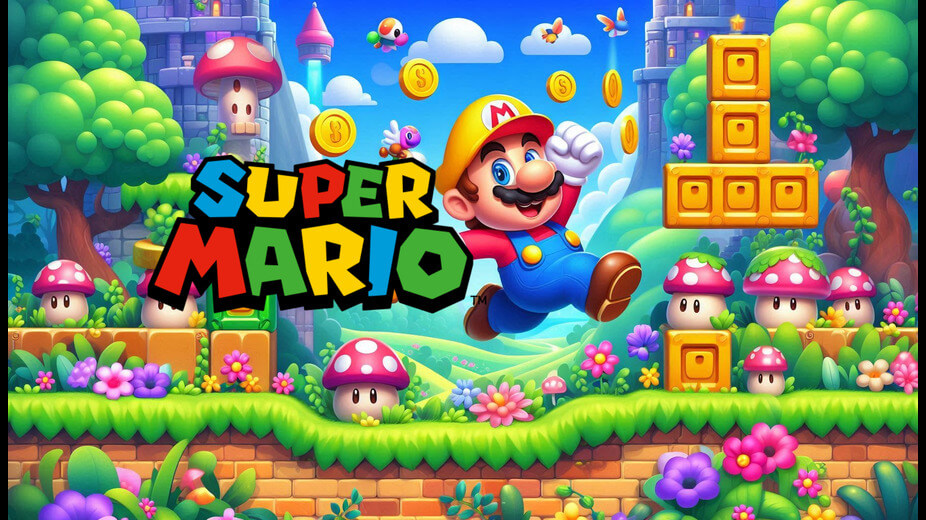
Introduction
There are few names in the world of entertainment as universally recognized as Super Mario. Whether you grew up clutching a chunky NES controller in the 1980s or downloaded a Mario title on a modern Nintendo Switch, chances are this little Italian plumber has left a permanent imprint on your childhood — and quite possibly your adulthood too.
Super Mario is not just a video game series. It is a cultural phenomenon, a benchmark of game design excellence, and the very foundation upon which the modern gaming industry was built. This blog takes a deep dive into the history, legacy, and enduring magic of the Super Mario franchise.
The Birth of an Icon: Where It All Began
The story of Mario begins not with a plumber, but with a carpenter. In 1981, Nintendo released Donkey Kong in arcades, featuring a stout, mustachioed character called "Jumpman" — who would later become Mario. The character was designed by the legendary Shigeru Miyamoto, who gave him a hat (to avoid animating hair), a mustache (to avoid animating a mouth), and overalls (to make arm movement visible). Practical design decisions that, by chance, created one of the most iconic looks in pop culture history.
Mario made his proper debut as a named character in Mario Bros. (1983), an arcade game where he and his brother Luigi battled underground creatures in the sewers of New York. But it was two years later that everything changed forever.
Super Mario Bros. (1985): The Game That Saved an Industry
In 1985, Nintendo released Super Mario Bros. for the Nintendo Entertainment System (NES). This was no ordinary game launch. The North American video game market had crashed catastrophically in 1983, with consumer confidence at an all-time low. Retailers were skeptical. Parents were uninterested. And then came Mario.
Super Mario Bros. was a side-scrolling masterpiece that introduced players to the Mushroom Kingdom — a vibrant world filled with colorful enemies, hidden secrets, underground tunnels, underwater levels, and sky-high castle fortresses. Players guided Mario through eight worlds, each with four levels, all in pursuit of rescuing Princess Peach from the villainous Bowser.
The game sold over 40 million copies and is widely credited with reviving the global video game industry. Its tight controls, intuitive design, and sense of discovery set a standard that developers still aspire to today.
Key Features That Made It Revolutionary:
- Smooth, responsive side-scrolling gameplay
- A consistent set of rules the player could intuitively learn
- Hidden blocks, warp zones, and secret areas that rewarded curiosity
- A memorable chiptune soundtrack by Koji Kondo
- Power-ups like the Super Mushroom, Fire Flower, and Super Star
The Evolution of Mario: From 2D to 3D and Beyond
What makes the Mario franchise truly extraordinary is its ability to reinvent itself with every new hardware generation, while never losing the core spirit of fun and exploration.
The NES Era (1985–1990)
After the original, Nintendo released Super Mario Bros. 2 (1988) and Super Mario Bros. 3 (1988/1990). The third entry is widely considered one of the greatest games ever made — introducing new suits, a world map, and an incredible variety of level types.
The SNES Era (1990–1995)
Super Mario World (1990) launched alongside the Super Nintendo and pushed 16-bit visuals to their limits. It introduced Yoshi, Mario's lovable dinosaur companion, and featured 96 exits across its sprawling map. Super Mario RPG (1996) later blended the franchise with role-playing elements, hinting at just how flexible the Mario universe could be.
The N64 Era: The Leap to 3D (1996)
Perhaps no single moment in gaming history is as significant as the launch of Super Mario 64 in 1996. It was the first fully 3D Mario game and one of the first 3D platformers ever made. Players were dropped into Peach's Castle and could freely explore in all directions — a concept so new and exciting that gamers were speechless.
Super Mario 64 essentially wrote the rulebook for 3D game design. Camera control, analog movement, and open-world exploration were all pioneered or perfected here. It remains a landmark achievement even today.
Sunshine, Galaxy, and Odyssey
Each subsequent 3D entry pushed boundaries further:
- Super Mario Sunshine (2002) — Tropical adventure with F.L.U.D.D., a water-pack gadget
- Super Mario Galaxy (2007) — Gravity-defying platforming across tiny planets in outer space
- Super Mario Galaxy 2 (2010) — Widely considered one of the highest-rated games ever made
- Super Mario Odyssey (2017) — Open-world platforming with Mario's sentient hat, Cappy
Each game was not just a sequel — it was a reimagining of what a Mario game could be.
The Characters: A Cast Unlike Any Other
One of Mario's greatest strengths is its memorable cast of characters — heroes, villains, and everything in between.
| Character | Role | First Appearance |
|---|---|---|
| Mario | The heroic plumber and main protagonist | Donkey Kong (1981) |
| Luigi | Mario's taller, timid younger brother | Mario Bros. (1983) |
| Princess Peach | Ruler of the Mushroom Kingdom | Super Mario Bros. (1985) |
| Bowser | The fearsome King of the Koopas and main antagonist | Super Mario Bros. (1985) |
| Yoshi | Mario's loyal dinosaur companion | Super Mario World (1990) |
| Toad | Loyal servant of the Mushroom Kingdom | Super Mario Bros. (1985) |
| Wario | Mario's greedy, self-serving rival | Super Mario Land 2 (1992) |
| Rosalina | Guardian of the cosmos and Lumas | Super Mario Galaxy (2007) |
Mario Beyond Platformers: A Universe of Genres
What is remarkable about the Mario franchise is how Nintendo has fearlessly expanded it into virtually every gaming genre imaginable — and dominated each one.
- Racing: Mario Kart series (1992–present) — One of the best-selling game series of all time
- Sports: Mario Tennis, Mario Golf, Mario Strikers, Mario Baseball
- Party Games: Mario Party series — The cause of countless broken friendships
- RPG: Super Mario RPG, Paper Mario series, Mario & Luigi series
- Puzzle: Dr. Mario (1990)
- Education: Mario Teaches Typing (1991)
No other single franchise has successfully spanned this many genres while maintaining such consistently high quality.
The Music: Koji Kondo's Immortal Compositions
It is impossible to talk about Mario without talking about its music. Composed by Koji Kondo, the Mario soundtracks are among the most recognized pieces of music on the planet. The overworld theme from Super Mario Bros. is as famous as any pop song ever written.
Kondo's genius was in creating music that perfectly matched the energy of gameplay — upbeat and urgent during normal levels, tense and bubbling underwater, triumphant at the end of a world. The music didn't just accompany the game; it became the game.
"I want people to feel the music physically — not just hear it, but feel it as part of the game world."
— Koji Kondo
Super Mario in Popular Culture
Mario's impact extends far beyond video games. The franchise has permeated nearly every corner of global culture:
- Film: The Super Mario Bros. Movie (2023) became one of the highest-grossing animated films of all time
- Theme Parks: Super Nintendo World exists in Universal Studios Japan, Hollywood, and Orlando
- Merchandise: Billions of dollars in toys, clothing, and collectibles worldwide
- Esports & Speedrunning: Mario games are among the most popular speedrunning titles globally
- Education: Mario Maker has introduced game design concepts to millions of players
Why Mario Still Matters Today
In an age of photorealistic graphics, massive open worlds, and billion-dollar game budgets, one might wonder why a cartoon plumber from 1985 still commands such devotion. The answer lies in something timeless: pure, joyful fun.
Mario games are not about power fantasies, gritty realism, or complex narratives. They are about the simple pleasure of movement — of jumping perfectly, discovering a hidden passage, hearing a coin chime, or finally defeating a castle boss on the last life. These feelings are universal and ageless.
Nintendo has also shown extraordinary care for the franchise. They never rush a Mario title, never oversaturate the market, and consistently prioritize quality and innovation over profit. That discipline has earned them something priceless: the trust of their fans.
Fun Facts You Might Not Know
- Mario was originally called "Jumpman" and was a carpenter, not a plumber.
- The name "Mario" was inspired by Mario Segale, Nintendo of America's landlord at the time.
- Bowser was originally intended to be an ox, based on a misread kanji character during development.
- The classic underground music loop in Super Mario Bros. is only a few seconds long — it loops seamlessly.
- Mario's full name is Mario Mario — officially confirmed by Nintendo in 2015.
- There are over 200 games in the extended Mario franchise.
- New Super Mario Bros. Wii required a special disc loading mechanism because the cartridge was so packed with data.
Conclusion: A Legacy That Will Never End
Super Mario is more than a franchise — it is the soul of video gaming. It was there when gaming needed saving. It was there when gaming needed to grow up. And it continues to be there, evolving with every generation, yet always remaining unmistakably, joyfully Mario.
Shigeru Miyamoto once said that a delayed game is eventually good, but a rushed game is forever bad. That philosophy — patient, principled, and player-first — is exactly why, more than four decades after Jumpman first leaped across an arcade screen, we are still watching that little plumber run, jump, and save the world. And we always will be.
Thank you, Mario. For everything.